 NaturalRewrite
AI Humanizer vs Paraphraser: Which Bypasses AI Detection?
You've got AI-generated text. You need it to pass a detector: Turnitin, GPTZero, Originality.ai, take your pick. So you open a paraphraser. It shuffles a few words, swaps some synonyms, and hands back something that still reads like a machine wrote it.
That gap catches a lot of people off guard. An AI humanizer and a paraphraser look like the same type of tool, but they solve different problems. One varies your phrasing. The other rewires how your text is structured at a deeper level, specifically to remove the patterns that AI detectors are trained to catch.
If you've been running AI text through a paraphraser and still getting flagged, this is why.
An AI humanizer and a paraphraser both rewrite text, but they're built for different goals. Paraphrasers rephrase sentences to vary wording or reduce plagiarism risk. AI humanizers are built to remove the structural patterns that detection tools flag. If your goal is to bypass AI detection, a humanizer is the right tool.
What a Paraphraser Actually Does
A paraphraser takes your text and rewrites it sentence by sentence. It swaps words for synonyms, changes sentence order slightly, and shuffles phrases around. QuillBot has been doing this for years, and it's genuinely useful for what it was built for.
The output looks different on the surface. But the underlying sentence patterns stay largely intact. Short, clipped sentences stay clipped. Formal academic phrasing stays formal. The rhythm is still mechanical, just with different words on top.
Paraphrasers were built for two jobs: avoiding plagiarism from a source, and helping writers vary repetitive phrasing. Surface-level variety is the point.
There's nothing wrong with that. It's a well-defined problem and paraphrasers solve it. The issue is that "AI detection bypass" requires something entirely different, and a paraphrasing tool won't get you there on its own.
What an AI Humanizer Does
An AI humanizer targets the structural layer. It looks at how AI-generated text is built and rewrites it to break those patterns.
AI writing has specific tells. Sentence lengths stay balanced throughout a paragraph. Transitions are consistent. The pacing doesn't change. Detectors like Turnitin's AI tools, GPTZero, and Originality.ai are trained to catch exactly these regularities.
Modern AI detection tools don't flag text because the words are unusual. They flag it because the patterns are predictable. AI models tend to produce text with consistent sentence length ratios, specific transition word frequencies, and low "burstiness" scores. Human writing is naturally uneven: a sudden short sentence, a long winding one, then another short one. A paraphraser changes the words without touching those patterns. An AI humanizer is built specifically to attack them. It varies sentence rhythm, restructures how ideas connect, and introduces the kind of controlled unevenness that makes text read as human-written. That's why paraphrased text still gets flagged at rates between 70% and 85% on major detectors, while text processed through a purpose-built humanizer is designed to pass those same checks consistently. The distinction matters: one tool solves for variety, the other solves for detectability.
NaturalRewrite, for example, runs text through a multi-model AI pipeline, not just a synonym swap. The 5 tone modes (Standard, Casual, Academic, Professional, Creative) let you match the output to the context. A humanized academic essay sounds different from a humanized blog post because you're setting the target, not just randomizing word choice.
Where Paraphrasers Break Down for Detection
The clearest way to see the gap is to test it.
Take a ChatGPT paragraph. Run it through QuillBot. Then run the output through GPTZero.
In most cases, GPTZero still flags it as AI. The words changed, but the patterns didn't. The sentence-level structure that detectors are trained on is still intact. (QuillBot was built for paraphrasing, and it does that job well. The problem is using a paraphrasing tool for a job it was never designed to do.)
Paraphrasers also hit a vocabulary ceiling. Formal academic terms don't have good synonyms, so paraphrased academic text either sounds awkward or barely changes at all. That's exactly the kind of writing that gets flagged most often, because academic AI output has the flattest rhythm of all.
Students submitting essays usually discover this the hard way: they paraphrase with QuillBot, check with GPTZero or Originality.ai, and the score barely moves. The structure underneath stayed the same.
Run the same paragraph through an AI humanizer instead, and the detection result changes. The text gets restructured, not just reworded.
See also: Can Turnitin Detect Paraphrasing?, which covers why paraphrasing alone doesn't fool modern detectors and what Turnitin specifically measures.
When Each Tool Is the Right Choice
Paraphrasers have real use cases. If you're rewriting your own human-written text to reduce plagiarism risk, a paraphraser works fine. If you're simplifying complex text for a different audience, it's the right tool. Non-native speakers using paraphrasers to vary sentence structure in their own writing? Completely appropriate use.
The mismatch happens when someone uses a paraphraser to remove AI detection patterns. That's not what they're built for.
For AI detection, the questions that narrow it down:
Is your concern passing a detector? Use a humanizer. Paraphrasers don't strip the structural features that Turnitin, GPTZero, and Originality.ai measure.
Are you rewriting human-written text to reduce plagiarism? A paraphraser is the better fit. You don't need deep structural rewrites.
Do you need to preserve a specific tone? An AI humanizer with tone controls gives you more precision. Academic tone stays academic. Casual stays casual.
Are you working short-form? NaturalRewrite's free Paraphrasing Tool handles up to 300 words with no account required. The humanizer scales from 300 words on free up to 5,000 words on Unlimited.
For most people dealing with AI detection, the paraphraser route costs time and doesn't fix the problem. Humanize first, verify with the built-in detection checker, and you'll know before submitting.
How NaturalRewrite Handles Both
NaturalRewrite is built around humanization, but it includes a free Paraphrasing Tool as well.
The humanizer is the core: paste your AI-generated text, pick a tone mode, click humanize. You get restructured output designed to pass major detectors. The built-in AI detection checker lets you verify the result before you use it. Free accounts get 3 checks per day; Starter and above get unlimited checks.
The paraphrasing tool is a separate free public tool on the site. No account required, 300-word limit. Good for quick rewrites where detection isn't the concern.
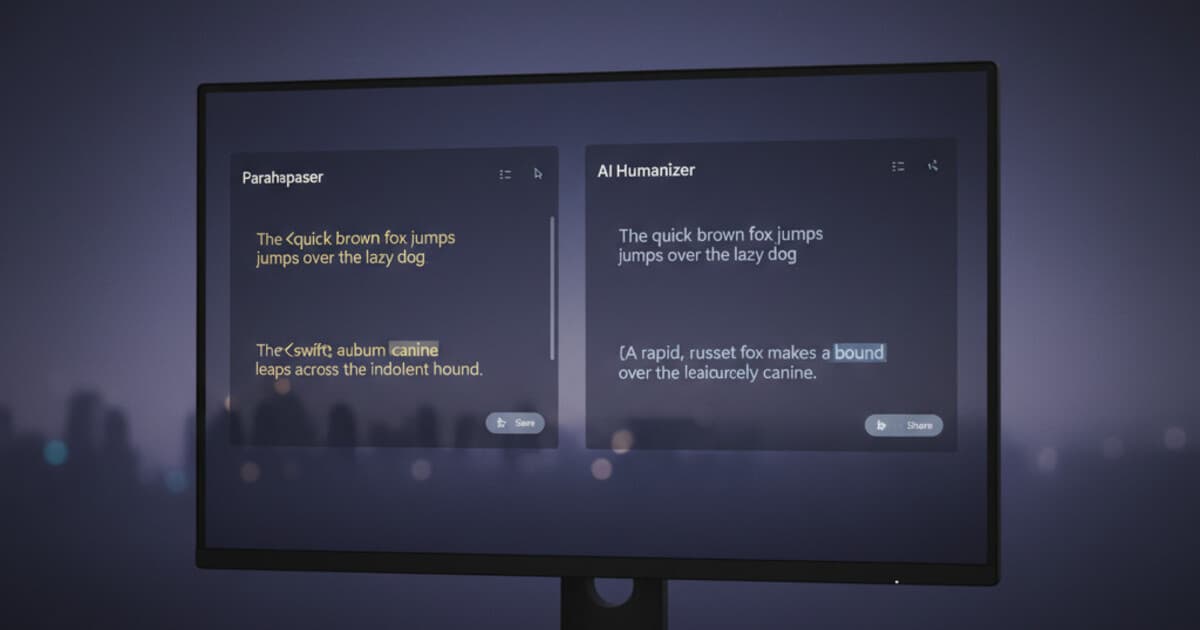
The difference in output is clear when you put them side by side. Run the same ChatGPT paragraph through both tools. The paraphrased version reads cleaner but still patterns like AI. The humanized version sounds like someone who sat down and wrote it.
NaturalRewrite also saves your usage history, so you can revisit previous humanizations without starting over. Free accounts keep 7 days of history; Pro and Unlimited accounts store everything.
For a broader look at humanizer options, Best Free AI Humanizer Tools in 2026 tests several tools head to head with detection rate comparisons.
Frequently Asked Questions
Can a paraphraser bypass AI detection?
Usually not reliably. Paraphrasers change word choice and surface sentence structure, but they don't address the underlying patterns that AI detectors measure. Turnitin, GPTZero, and Originality.ai look at structural features that paraphrasing alone doesn't strip out.
Is an AI humanizer the same as a paraphraser?
Both rewrite text, but for different goals. A paraphraser focuses on varying wording to avoid repetition or plagiarism. An AI humanizer is specifically trained to remove AI-writing patterns that detectors flag. Same input, different goal, different output.
Does QuillBot bypass AI detection?
QuillBot is a paraphraser built for varying text, not for AI detection bypass. Paraphrased text still gets flagged at high rates on Turnitin and GPTZero because those detectors measure structural patterns, not just word choice. If passing an AI detector is the goal, a dedicated humanizer is the right tool.
What's the best way to verify my text will pass a detector?
Use a humanizer that has a built-in detection checker. NaturalRewrite includes one so you can check your output before submitting, rather than finding out after it's already been flagged.
Can I use a paraphraser and a humanizer together?
Yes. Some people humanize first, then run a light paraphrase to add surface variety on top. In practice, properly humanized text usually doesn't need the extra step. For high-stakes submissions, the double pass can add confidence.
Conclusion
Paraphrasers and AI humanizers both rewrite text, but they're solving different problems. A paraphraser handles word-level variety. An AI humanizer handles the structural patterns that detectors are actually trained to catch. Knowing which one matches your problem saves time and avoids the frustration of running text through the wrong tool.
If you're dealing with AI detection on a deadline, a paraphraser isn't the right tool. NaturalRewrite's humanizer is built exactly for that, with 5 tone modes, a built-in detection checker, and a free tier that doesn't require a credit card. Try it at naturalrewrite.com.