 NaturalRewrite
How Accurate Are AI Detectors? (2026 Tests & Data)
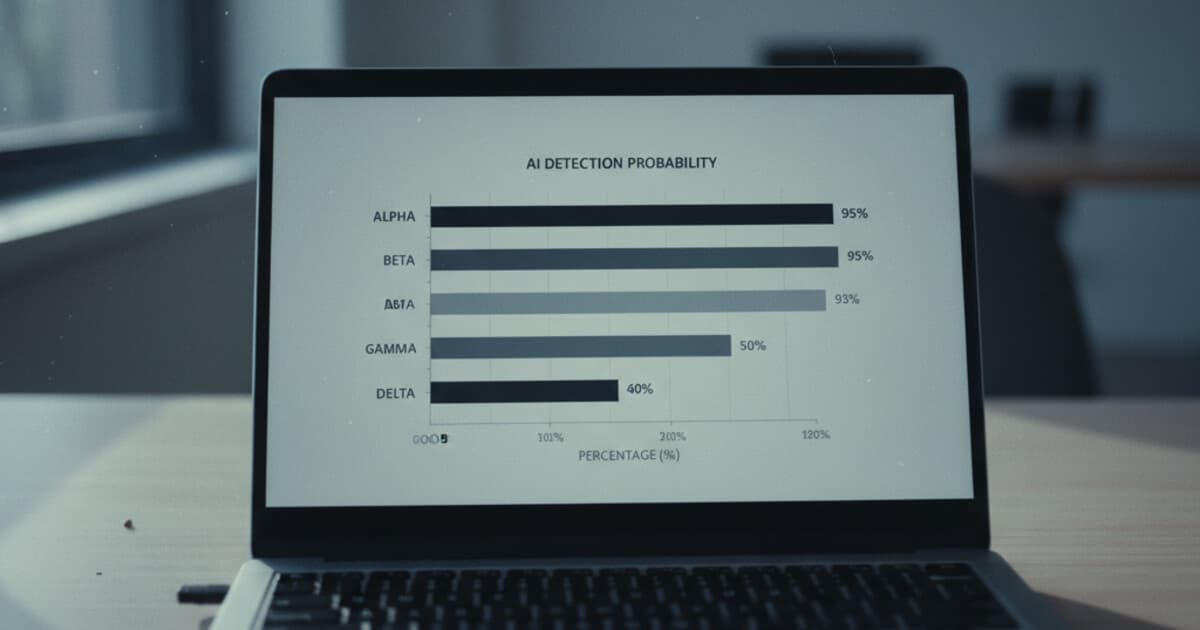
You paste your essay into a detector. It says 87% AI. Your professor, your editor, and your client all have their own tools, and none of them agree on where the line is.
The question underneath all of this: can you actually trust these numbers?
AI detectors have gotten faster and more accessible since GPT-4 made AI writing mainstream. Accuracy varies more than most people realize. Some tools catch AI content reliably; others flag human writing at rates that should make you skeptical of any single result.
Knowing how accurate AI detectors actually are helps you decide which tools to trust, which scores to take seriously, and what to do when a result comes back higher than you expected.
AI detectors range from about 60% to 95% accurate at catching unmodified AI content, depending on the tool. GPTZero and Turnitin sit at the higher end, with true positive rates around 85-92%. False positive rates (flagging real human writing as AI) vary widely, with some tools misclassifying human text 10-25% of the time.
What the Accuracy Numbers Actually Show
AI detector accuracy is measured two ways: how often it correctly catches AI text (true positive rate) and how often it wrongly flags human text (false positive rate). Both matter. A tool with a 95% detection rate sounds impressive until you learn it also flags 20% of human writing as AI.
Across independent tests in 2025 and 2026, AI detectors show wide variation in both metrics. GPTZero correctly identified AI-generated content in approximately 85-90% of tests on pure ChatGPT output, with false positive rates around 8-12% on general human text. Turnitin's AI detection reports rates above 90% for unmodified AI text, but its false positive rate rises sharply for human writing in formal academic style. Originality.AI claims 99% accuracy in its marketing, but independent tests show closer to 88-92% on real-world documents. ZeroGPT and Sapling score lower across both metrics, with detection rates around 65-75% and false positive rates that can exceed 25% for non-native English writing. The takeaway: no single detector gives a definitive verdict. Every tool's accuracy drops when text has been edited, paraphrased, or written in a non-standard style.
The numbers also depend heavily on the source text. Pure ChatGPT output is easy for most detectors to catch. Text that's been revised, mixed with human edits, or lightly paraphrased is much harder.
Real-world accuracy figures tend to run 10-20 points lower than the benchmarks the tools publish about themselves.
How AI Detectors Get It Wrong
Two failure modes show up most often: false positives and false negatives.
A false positive is when a detector calls human writing AI. This matters most in academic settings, where a false flag can carry real consequences for a student. AI detection false positives are more common than most people expect, especially for non-native English writers, people with formal writing styles, and anyone who edits their work into a clean, consistent voice.
Those same patterns that humans prize in writing (clarity, parallel structure, consistent tone) are also the patterns AI models produce. That's the core problem: the detector can't always tell the difference.
A false negative is when AI text slips through undetected. This happens regularly with edited or humanized content. An unmodified GPT-4 output might score 90% on GPTZero. After a round of serious manual editing, that same text often drops to 15-30%.
Most detectors struggle most with lightly edited AI content: text that's been touched by a human but not thoroughly reworked. That gray zone is where scores cluster around 40-60%, where neither the tool nor the person reading the score knows what to make of the result.
How Accurate Are AI Detectors, Tool by Tool
Here's what independent testing shows for the major tools. All figures reflect performance on unmodified AI text unless noted.
GPTZero: Detection rate roughly 85-90%, false positive rate around 8-12%. One of the more reliable options for academic content. Sentence-level highlighting makes it practical for pinpointing which paragraphs are pulling a score up. Full analysis in Is GPTZero Accurate?.
Turnitin: Claims detection rates above 90% for unmodified AI text. False positive rates climb significantly for formal academic writing in fields like law, medicine, and philosophy, where structured, precise language is standard. Details in Is Turnitin AI Detection Accurate?.
Originality.AI: Detection rates around 88-92%, targeted at content teams and publishers. Higher false positive rates on non-native English writing. More sensitive to lightly edited AI content than GPTZero. Full tests in Is Originality.AI Accurate?.
Winston AI: Marketed to educators and publishers with claimed accuracy above 99%. Tests put actual performance closer to 80-88% on varied content. Covered in Is Winston AI Accurate?.
Copyleaks: Detection rates around 78-85%. Moderate false positive rates. Frequently used in enterprise settings. Test results in Is Copyleaks Accurate?.
Scribbr: Academic-focused. Strong on formal essays and research papers, weaker on conversational or creative AI writing. Breakdown in Is Scribbr AI Detector Accurate?.
Sapling: Detection rates around 65-75%. Better suited for short-form content. Higher false positive rates than the academic-grade tools. Full breakdown in Is Sapling AI Accurate?.
ZeroGPT: Popular because it's free and needs no login. Detection rates around 65-75%, with false positive rates that can hit 25% or higher. Useful for a quick first check, but not reliable enough for high-stakes decisions. See Is ZeroGPT Accurate? for the full breakdown.
Why AI Detector Accuracy Varies So Much
Detectors work by analyzing statistical patterns: perplexity (how predictable each word choice is) and burstiness (how much sentence length varies throughout the text). How AI detectors actually work is more layered than a single percentage score suggests.
Training data is a key factor. Most detectors were built primarily on GPT-3 and GPT-4 output. They catch that model's patterns reliably. But Claude, Gemini, and newer models write with different patterns, and detection rates drop for that output until the tools retrain. This is why accuracy figures from 2024 often don't hold in 2026.
Writing context matters too. A detector calibrated on general web content performs differently on academic papers, code documentation, and marketing copy. Tools that excel at catching AI blog posts may struggle with AI-generated technical writing.
The human in the loop changes everything. Heavy manual revision, restructuring, adding personal anecdotes, or using a humanizer tool can drop detection rates dramatically. The text genuinely no longer matches the original AI patterns after thorough editing.
How NaturalRewrite's Checker Fits In
If you're working with AI-assisted content and need to verify it before submitting, running against a single detector isn't enough. Tools disagree, training data varies, and the stakes are too high to trust one number.
NaturalRewrite includes a built-in AI detection checker that runs your text against multiple detection models and returns a consensus view of where you stand. Compare across detectors, identify the tool most relevant to your situation, and fix what needs fixing before it goes anywhere.
The workflow is check, humanize if needed, recheck. Pick a tone mode (Standard, Casual, Academic, Professional, or Creative), get a rewritten version, and run the checker again to confirm the score dropped. The free tier covers 3 detection checks per day and 300-word humanization; Starter ($7/month) removes both limits for regular use.
Frequently Asked Questions
Which AI detector is most accurate in 2026?
Based on independent testing, GPTZero and Turnitin consistently score highest for accuracy on academic and general content, with true positive rates around 85-92% for unmodified AI text. Originality.AI performs similarly for content-marketing use cases. No tool hits 100%, and all have documented false positive rates on human writing.
Can AI detectors be fooled?
Yes. Edited or humanized AI text regularly drops detection rates from above 85% down to 15-30% on most tools. Detectors were trained primarily on unmodified AI output; text that's been thoroughly revised looks different enough statistically that scores drop substantially.
Do AI detectors work the same on all AI tools?
No. Most detectors were trained on ChatGPT and GPT-4 output. Detection rates drop for Claude, Gemini, Mistral, and newer models with different writing patterns. A tool that catches 90% of ChatGPT output may only catch 60-70% of output from a different model.
What counts as a high AI detection score?
Above 50% probability means most detectors would flag your text as likely AI. Below 20% generally reads as human. The range between 20-50% is ambiguous: some tools flag it, others don't. For high-stakes submissions, aim to get your score below 20% on the specific detector your audience uses.
Should you trust a single AI detector result?
For rough guidance, yes. For high-stakes decisions, run at least 2 tools. They disagree often enough that a second opinion changes the picture. Prioritize the tool your professor or client actually uses, since different models are calibrated for different contexts.
Conclusion
AI detectors are a useful filter, but they're not a definitive judgment. The most reliable tools hover around 85-92% accuracy on unmodified AI text. Free tools often miss 25-35% of AI content and carry real false positive risks. No single result tells the full story.
If you need to check your content before submitting and clean it up in one place, NaturalRewrite gives you a free built-in AI detection checker alongside a humanization tool so you can see your score, fix what needs fixing, and verify the result before anything goes out.